
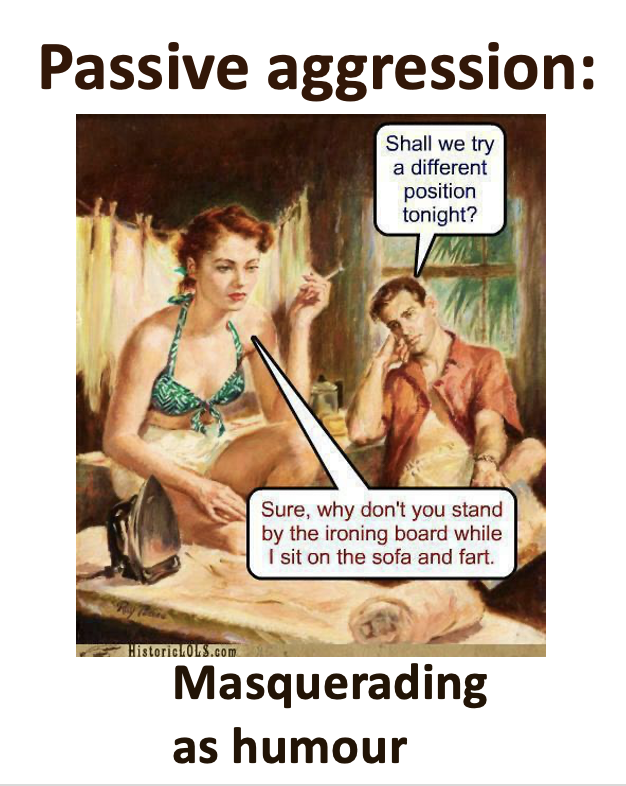
This is how the dictionary defines it:

It is a sad fact that many of us are, in fact, extremely passive aggressive. Is this perhaps because we confuse confrontation with anger? Passive aggression is a tool many women use, because they may still believe that they have to be good girls, which requires women to be compliant and accommodating. We have really turned passive aggression into an art form. If you Google passive aggressive, you will see an endless stream of jokes which just supports my theory that it is rife.
Let’s see how it could manifest – I’ll give you an example.
I lived with a house mate some years ago. We all have our quirks and likes and dislikes and these may even cause conflict when we live in close proximity to each other. I can be a tad untidy by leaving things lying about where they should not be. I particularly do this with my shoes. If I am sitting on the couch watching TV I may take my shoes off and when I go to bed, leave them in the lounge. One morning I woke up and went to the kitchen to make coffee for myself and found my shoes on the dining room table. I immediately understood the message and at the same time recognised the underlying passive aggression.
My house mate was one of the sweetest women I know. For me, passive aggression is our inability to tell others how we really feel, but we still want to make them aware that we are extremely unhappy with something they are doing that we really dislike or disapprove of.
We avoid conflict by being passive aggressive.
But do we really? I was extremely angry and upset about my house mate’s behaviour. I would have felt a great deal more comfortable if she had simply said something like, “Hilds, it really upsets me if you leave your shoes lying about. Please will you take them to your room when you go to bed?” After several of these incidents the atmosphere is our home changed radically and eventually one of us moved out. I do believe this irreparably damaged our friendship.
Passive aggression becomes habituated in our lives and when that occurs, we really have no other way of dealing with conflict. I also observe that many people do not believe that they are passive aggressive at all. I know for a fact my room mate meant no real harm by leaving my shoes on the table – I am sure she hope that I would get the message and just stop doing what she so clearly disapproved of.
It manifests in many other ways. I have a habit of leaving cupboard doors open. If I have a passive aggressive partner, they may very well walk into the room and slam the doors shut loudly. This could be followed by a conversation that goes something like this:
“Hun, are you okay?”
“Yes, why are you asking?”
“I heard you slam the cupboard doors.”
And if your partner has no peaceful conflict resolution skills, this could turn nasty.
“I slam them because you are forever leaving the cupboard doors open and you expect me to close them. You behave like a child and I always have to clean up after you.”
The passive aggressive behaviour has now caused such a huge argument, which could very easily have been avoided by simply saying, “I have a thing about open cupboard doors. Please will you mind closing them after yourself?” It may even be necessary to mention this a few times so that your partner really understands that this is a problem for you. The sad fact is people who use passive aggression as a conflict resolution strategy, use it all the time for many things and the partner at whom it is aimed begins to react angrily, or aggressively, themselves. This creates a cycle of relentless discomfort and ongoing resentment, which is never a good thing for any relationship.
If we know that something we do upsets those close to us we could modify our behaviour to accommodate them. If they tell us kindly that our behaviour is upsetting them. More often than not, we will modify our behaviour because none of us really want to live with constant conflict.
Let me relate another incident from my life. At night when I go to bed, I take my clothes off and can just leave them on the floor where I took them off. I have absolutely no requirement that anyone pick up after me and I will pick everything up and put it in the appropriate place the next day. Every morning Roy brought me my morning coffee, I could see that he was mildly annoyed. When I asked what was wrong, he avoided the conversation. Eventually it became very uncomfortable for both of us and it started affecting the peace in our home. One day when I asked him to really tell me what was going on he said, “Every morning when I bring you your coffee, your clothes are lying on the floor and I have to navigate around them to put your coffee on the beside table.” From that day on I learned to put my clothes on the chair instead of next to my bed on the floor. A simple conversation resolved months of discomfort.
I think many of us believe if we address conflict we are fighting – but that is not true. We can resolve conflict without aggression or anger. By not addressing issues we think we are avoiding angry confrontation and all we are doing is creating resentment within ourselves which will eventually cause an emotional explosion. Using passive aggression as an avoidance tactic never resolves any issues. All it does is make us feel as if we are out of integrity with ourselves and therefore the conflict is internalised instead of being expressed. This feeling builds up like a pressure cooker inside of us and it is inevitable that there will be an emotional explosion sooner or later. This emotional explosion will then be seen by those close to us as an overreaction for the tiny thing that may have triggered the explosion. Those close to us are seldom aware of the pressure building up while we are avoiding conflict situations.
I truly believe that this type of avoidance of conflict and our inability to state what it is that we need kindly and consistently, is the cause of most of our relationship woes. When we begin to understand that we can address relationship issues kindly and considerately instead of passive aggressively or sarcastically, our relationships improve exponentially.
I am not suggesting that this is an easy thing to do. It takes courage and consistency. It is however, something we really need to learn to do if we want to have better relationships. Compassion and kindness is key here for me. Sarcasm and passive aggression will never serve your relationships. Never! This behavioural change does not happen overnight. We easily slip back into our habituated negative behaviour patterns and it is entirely up to us to change our behaviour.
A close friend of mine said to me not so long ago, “But why do I have to change my behaviour. Why doesn’t he change his?” I told her that if her approach towards him changed his response to her will change. She phoned me a few months later to tell me that she can’t believe the difference in her husband. By changing her behaviour, he began to feel less put upon and his reaction to her softened significantly.
Passive aggression is a terrible trap that we fall into. I serves no one – east of all ourselves. Learn to manage conflict with kindness and compassion and really begin to understand that conflict cannot be resolved with sarcasm or passive aggression.